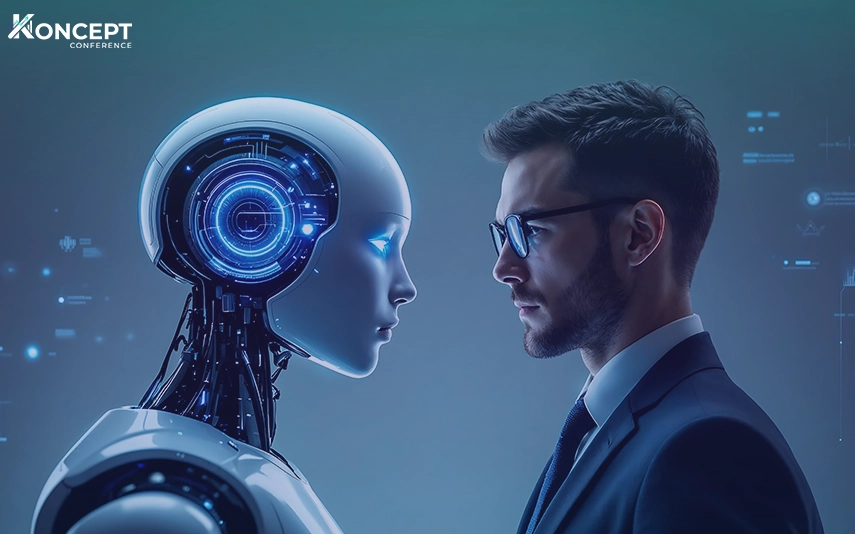
The Future of Collaboration between Multimodal AI and Humans
February 12, 2026
Summary: The concept of multimodal AI is transforming the human-machine interaction, whereby text, voice, image, and data inputs are incorporated to create more comfortable and effective interactions. This technology is changing the way work is done, both in the enterprise level as well as in the creative industries. Tech conferences in Dubai are the platforms of innovation that accelerate adoption to assist the organization to explore partnerships and futuristic solutions.
A designer interacts with a system, draws on a tablet, and sends reference pictures - simultaneously. The machine listens, deciphers and answers in a few seconds with a perfect prototype. This is not a distant vision. It is the current direction of multimodal AI, a technological paradigm shifting the ways human beings and machines collaborate in workplaces.
Multimodal AI is defined as the artificial intelligence systems which are able to process and combine various kinds of data such as text, voice, images, video and even sensor data in real time. As opposed to the classic AI models, which concentrate on one input channel, multimodal systems integrate data of different origin, thus allowing more context, superior decision-making, and more natural human-computer interaction.
Multiple Intelligence; Multimodal Intelligence
Simply, multimodal AI is akin to human perception. Sense of touch is hardly used by humans, we read the expression, listen to the voice and see in tandem. The same principle is applied to digital systems through multimodal AI. One example is in the healthcare sector where a multimodal model would be used to examine the patient records, medical images and voice notes to avert quicker diagnoses. In production, it is capable of giving data of machine sensor with visual inspection in order to enhance the quality control.
Fusion of data streams enables the development of systems that are more accurate as well as adaptive. Machines are now able to interpret intent, context, and nuance, rather than responding to isolated commands, and make collaboration less mechanical and more of a more conversational type.
Revamping Human-Machine Co-operation
The future of work does not involve substituting human beings with machines, but increasing the power of the human being. Multimodal artificial intelligence is a central part of this development, as it can provide a consistent interaction between platforms and environments.
1. Creative Collaboration
Multimodal AI is already being used by designers, marketers and content creators to brainstorm, generate and refine ideas. He or she is allowed to post pictures, give voice instructions and get written suggestions all at the same time. This iterative process speeds up the ideation process and shortens the gap between idea and action.
2. Industrial and Enterprise Applications
Multimodal AI enhances efficiency in the operations of an enterprise. Customer service platforms are able to decode text messages, voice, and user behavior patterns in order to provide more personalized services. The systems are able to process video footage, route information and weather data to maximize delivery efforts in the domain of logistics.
3. Accessibility and Inclusion
Multimodal interfaces can help to increase the accessibility in that a user can utilize speech, gestures, or visual inputs. This elasticity facilitates the different user requirements and thus technology is more accommodating and user friendly.
The role of Global innovation hubs
The adoption of technology is not something that occurs on its own. The conferences, exhibitions, and innovation summits serve as the stimuli of collaboration and sharing of knowledge. The conferences that include the exhibitors of Dubai technology conference exhibitors the way in which organizations are adopting multimodal AI into practical use-cases- whether in smart cities or in healthcare innovation.
Likewise, major tech conferences in Dubai are emerging as the hubs of presenting multimodal systems, discussing ethical standards, and developing strategic alliances. These activities bring developers, enterprises and policymakers together forming an ecosystem where ideas are then transformed into deployable solutions.
In order to establish partnerships or involvement in organizations, approaching a trusted conference contact Dubai may give the network access and partnership, product promotion, and joint research works. With the increase of multimodal AI, these international conferences will influence its real-world application in industries.
Ethical and Operational Issues
Although multimodal AI has a transformative potential, it also creates challenging issues. Issues of privacy of data, model bias and transparency are still important. Organizations that have various types of data to process (especially voice and video) need to have well-built governance structures to have ethical usages.
Besides, companies should invest in training employees. The collaboration between humans and machines presupposes that employees will learn to interpret AI outputs, check facts, and ensure control. The aim is not complete automation but augmented intelligence, i.e. machines are used to augment the decisions and expertise of humans and not to substitute them.
The Road Ahead
Multimodal AI will be integrated into industries in the next decade. Starting with independent cars that observe the images and sounds and going to a business platform that combines communication channels, the boundaries of cooperation will increase exponentially.
The next generation systems will tend to be real-time multimodal process, which will lead to immediate reaction between devices and environment. It will redefine the process of team collaboration, product development, and service provision when teams work remotely.
Dubai technology conference exhibitors, and large technological conferences in dubai, will be important to demonstrate innovations and industry standards. With organizations interacting with a trusted conference contact in Dubai they can have access to partnerships to hasten adoption and innovations.
Conclusion
Multimodal AI is not simply the deepening of machine ability, it is also a paradigm shift in the way humans and technology will interact. Combining various types of data and facilitating more natural interaction, these systems are changing cooperation in creative, industrial, and enterprise environments.
Whether multi-modal AI will affect human-machine collaboration is no longer on the agenda as the field of multimodal AI is being investigated by businesses as part of how the vision of the future of work. The actual issue is the speed at which organisations will change so that they can exploit its entire potential. Investors in the learning and application of this technology today will set the collaborative systems of tomorrow.
FAQs
1. What is multimodal AI?
Multimodal AI is an artificial intelligence platform that receives and combines several types of data, including text, images, audio, and video, to produce more contextual and precise results.
2. What is the role of multimodal AI in enhancing collaboration?
It allows more natural interactions between people and machines through interpretation of context among various inputs and makes workflows more intuitive and quicker.
3. What are the industries that multimodal AI is most useful in?
Some of the fields where multimodal AI is transforming considerably are in healthcare, manufacturing, marketing, logistics, education, and customer service.
4. What is the significance of international technology conferences to the implementation of AI?
Exhibitions with Dubai technology conference exhibitors and other innovation leaders assist organizations to learn new technologies, establish collaborations, and run with new trends.
5. What are the problems of applying multimodal AI?
The main issues are the privacy of data, ethical concerns, hardware needs, and the presence of the professional workforce who are capable of handling AI systems.
Interesting Reads:
Deepfake Detection Technologies: How Modern Systems Spot Fakes