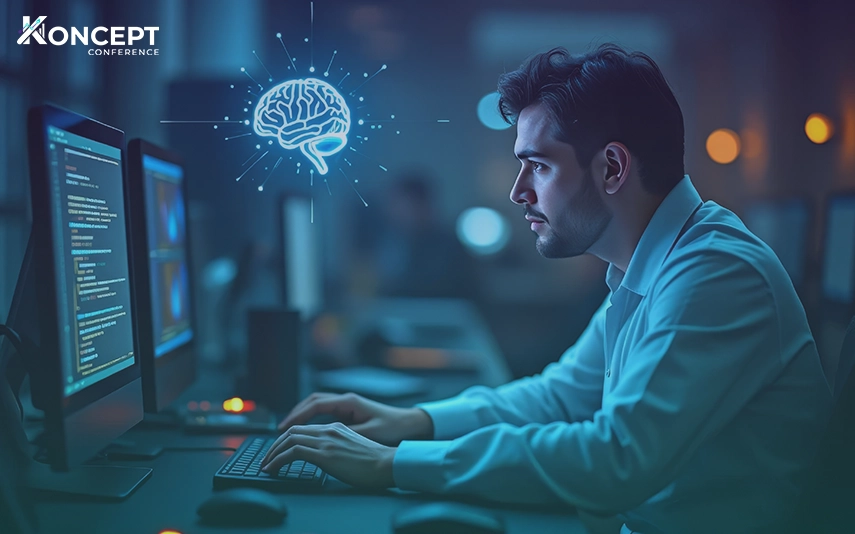
Brain-Computer Interfaces: Controlling Devices with Thoughts
April 14, 2026
Imagine turning the volume, typing, or moving a robotic arm without moving a finger. That concept is no longer in science fiction. It begins to form itself with the fast innovation and research. Brain-computer interfaces enter the scene here and, in a silent manner, redefine human-machine interactions.
Technology is ever narrowing down the intention-action divide. Devices are more responsive, systems become more perceptive, and interaction is more natural. As this changes, the concept of controlling machines by thinking begins to seem not so much like a far-off dream but as a new reality that is beginning to emerge.
What Are Brain-Computer Interfaces?
Simply put, brain-computer interfaces are devices that directly relate human brain signals to the external devices. These machines understand neural activity, decode patterns, and convert them into machine-comprehensible commands.
The procedure might seem complicated, but the idea remains easy. A device reacts to sensors that pick up the brain signals, software decodes the signals, and a device reacts. This chain enables the users to act without physical actions leading to the appearance of new opportunities to be more accessible and efficient.
How Does This Technology Work?
The knowledge of the operation of brain-computer interfaces can be useful in de-mystifying the experience. The brain generates electrical impulses whenever an individual thinks, moves, or concentrates. BCI systems are able to detect these signals through electrodes applied on the scalp or even within.
After being caught, the signals are analyzed by the algorithms and compared to the predefined actions. With time the system becomes trained and becomes more accurate. This is a learning process, which implies that users have to train the system and vice versa.
Real World Applications
The actual effect of Brain-Computer interfaces is manifested in real-life applications. Within the medical field, BCI systems are used by paralyzed people to operate prosthetic limbs or communicate via a digital display. This change brings about a feeling of independence.
Outside the medical field, hands-free control systems are investigated by industries. Thought-driven interaction continues to be experimented with by gaming, virtual reality, and smart environments. These applications are an indication of a greater change towards intuitive technology.
Benefits That Matter
Brain-Computer interfaces have significant benefits beyond convenience. They establish new avenues of communication to physically challenged people. That influence in itself transforms lives in a drastic manner.
Moreover, the technology enhances efficiency in finely tuned tasks. Procedures that require prompt action can be served with immediate brain input. There can also be reduced workflows since the physical interfaces are relied on less in industries.
Challenges and Limitations
Nevertheless, Brain-Computer interfaces are yet to overcome numerous challenges. The issue of accuracy is also quite problematic since brain signals differ among individuals as well as circumstances. Minor discrepancies can result in unintentional behaviors.
Data privacy and security are also of concern. Brain data is highly personal, and the protection of this data has to be considered carefully. Ethical questions remain the determinant of the evolution of this technology.
The Future of Thought Driven Technology
The future of Brain-Computer interfaces is bright, and it is being researched to the limits. In everyday life, systems can be less invasive, more precise, and convenient.
With further evolution, it might be possible to integrate with the artificial intelligence to develop a more precise interpretation of thoughts in machines. Such a combination might result in smooth communication between humans and digital surroundings, as digital technology would be nearly invisible.
Conclusion
Brain-Computer interfaces represent a shift in how humans connect with machines. The journey from physical interaction to thought based control signals a new phase of innovation.
As this technology evolves, it may redefine independence, accessibility, and efficiency in ways that feel both subtle and powerful.
Partner with Koncept Conference today and be part of the future of global tech innovation.
Interesting Reads:
Why Start-ups Fail in Tech Industry: The Secret Struggles No One Tells