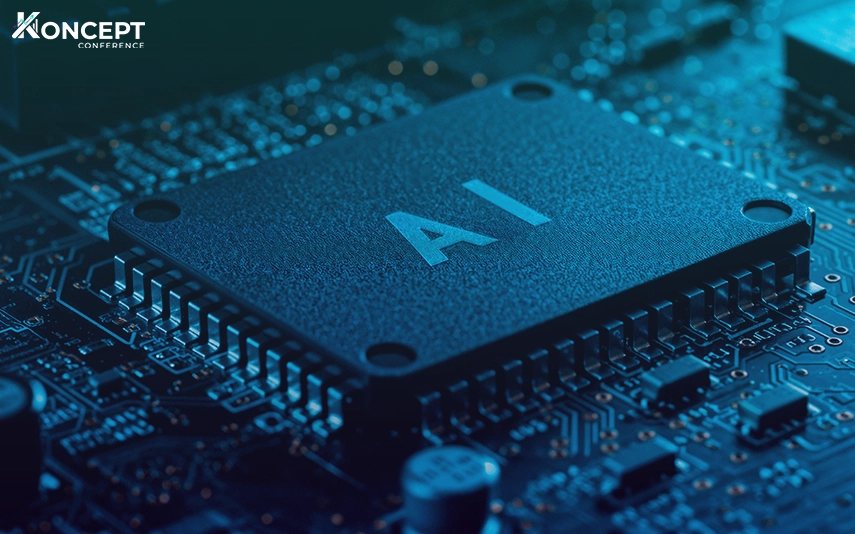
AI Chips Explained: Why Hardware Is the Tech Race to the Top
April 1, 2026
The upcoming tech royalty battle is not taking place in the screens of smartphones or in the slick software interfaces. It is currently unfolding in the silent, high-stakes world of silicon - within data centers, research laboratories, and semiconductor fabs where AI chips are recreating the future of the very intelligence.
Any news of the new generative AI, autonomous systems, or intelligent search engine has a darker secret: none of it is without the hardware underneath it. The actual race is no longer the one of who will create the smartest model. It is of who has the fastest, most efficient and most scalable compute infrastructure. In the current scenario, AI processors are the building blocks of innovation, the importance of software being superseded by that of semiconductor architecture. The new AI workloads are based on massively parallel tensors and matrix computations, and thus GPUs, TPUs, NPUs, and dedicated ASICs have become the new, hot topic of discussion.
The Secret behind AI Development
The glamour of AI might be deceptive to the eye, but it might be nothing more than typical mathematics at an unprecedented scale. Recommendation engines, computer vision systems, and huge language models need trillions of calculations within a few seconds. Conventional CPUs, designed to perform general purpose sequential jobs, just cannot compete.
It is here that AI chips transform the game.
In contrast with traditional processors, AI chips are designed in order to execute machine learning workloads. They are good at parallel processing, tensor computer operations, memory optimization, and power consumption. The above trait makes them many times faster to train and infer. What took days before can now be done in hours or even minutes since the silicon is designed to work specifically with neural networks.
That speed has its own advantage, not merely technical, but strategic. The accelerated chips imply accelerated model release, reduced inference costs and competitive standing.
Why Hardware Now Becomes the Real Tech Race?
Software companies have been winning over the years through better algorithms and user experience. AI has changed that equation.
The current bottleneck is the availability of a computer. The one having more access to advanced chips is able to train larger models, run more data, and scale AI products. This has made semiconductors the most valuable technology stack layer.
The race has now been taken round three dimensions:
1) Performance at Scale
Artificial intelligence is expanding at a very high rate. The jump in capability of every model requires additional memory bandwidth, faster interconnects, and higher throughput. Actually, the real limiting factor is in most cases memory movement and not raw compute.
2) Power Efficiency
AI systems require huge amounts of energy to run. The chips that provide superior performance per watt are now being given more priority by organizations. The efficient silicon lowers infrastructure expenses directly and makes AI implementation sustainable.
3) Supply Chain Control
The champions are not simply making chips but are acquiring capacity to make. Foundries, sophisticated packaging and the availability of the state-of-the-art nodes have become as significant as software talent.
New Battlefield: GPUs, TPUs, and Custom Silicon
The software race is not a one-dimensional race any more.
Gpus will continue to be the leader in the field of AI training due to their parallel structure and well-developed software stacks. The market is however changing at a fast rate. Cloud giants and hyperscalers are investing in their own silicon massively to decrease reliance on third parties.
Purpose built TPUs and ASICs are also gaining popularity as they provide workload efficient performance. These chips are special purpose, not general purpose, in that they are created to execute precise AI work with much less energy and latency. In most applications, custom silicon has the potential to open up significant efficiency improvements compared to traditional GPUs.
And this is why the hardware discussion has now expanded not only to include chipmakers but also cloud providers, device manufacturers, and enterprise infrastructure leaders.
The Future of Full-Stack AI Infrastructure
The most dramatic change is that the AI success is turning into a full-stack problem. The future is of the businesses that will be able to bring model architecture, chip design, memory systems, networking, and data center cooling into a single optimized ecosystem.
In plain words, the most intelligent AI will be made by the most intelligent hardware strategy.
This is why the actual technology race now is not simply a matter of developing superior models, but of the machines that ought to create superior models. With AI making new inroads in healthcare, finance, robotics and edge devices, AI chips will be the real currency of innovation.
The software will be the beginning of the next billion-dollar breakthrough, though it will be conquered in silicon. Visit at - Koncept Conference
Interesting Reads:
Why Start-ups Fail in Tech Industry: The Secret Struggles No One Tells